Tada no Iki
Norwegian WoodThe field well is an unseen, possibly imaginary danger described by Naoko during a walk with Toru Watanabe. Once she gives it shape in words, it becomes inseparable from his memory of the meadow, an image of hidden peril that gathers meaning from their closeness, later loss, and Watanabe’s effort to understand how death inhabits the lives of the living.
An Unseen Opening at the Meadow’s Edge
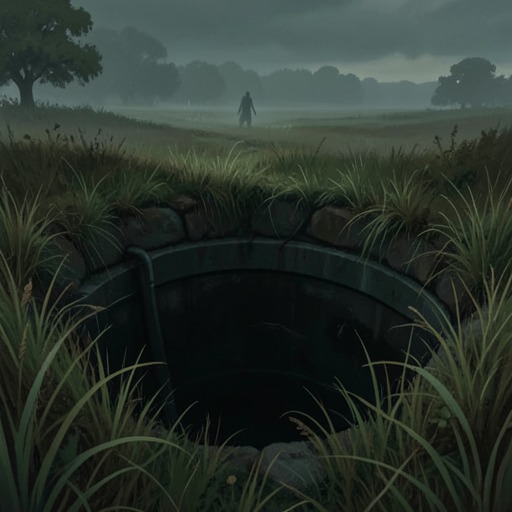
Watanabe cannot establish whether the well exists in the physical landscape. He considers that it may be an image or sign that exists only within Naoko, like other things she created in her mind during her dark days. Yet her description alters his perception of the meadow: from then on, he cannot recall the place without the well. An object he has never seen becomes fused with a real scene he remembers.
The well lies precisely where the meadow ends and the woods begin. Grass conceals a dark opening about a yard across; there is no fence or stone curb rising above ground to mark its perimeter. Its collar is made of weathered, muddy-white stones, cracked and missing pieces, with a small green lizard slipping into a seam. Leaning over the edge reveals nothing. The details make the danger sharply imaginable while preserving its defining uncertainty: no one can see how far down it goes, only that its darkness seems beyond measurement.
Naoko’s Account of the Danger
Naoko speaks carefully, insisting that the well is very deep and somewhere around there, though nobody knows its precise location. She describes people who suddenly disappear and are said to have fallen into it. The possible death is not swift or clean: a person might break a leg rather than their neck, be unable to move or make anyone hear their cries, and die slowly in darkness among insects and the bones of earlier victims. High above, the only light would be a tiny circle like a winter moon.
Watanabe answers that the well sounds dangerous because someone could fall in and die. Naoko agrees that it is terrible, brushes grass seed from her jacket, and says no one can find it, so he should stay on the path. The contrast between her practical warning and the impossibility of locating the hazard leaves the threat unresolved. There is no way to build a wall around a danger whose position cannot be known.
A Promise Against the Dark
Naoko takes Watanabe’s hand and reassures him that he will be all right. She says that if she stays with him, she will not fall into the well either. When he asks how she can be so certain, she says she simply knows: when she is close to him, she is not afraid, and nothing dark or evil can tempt her. Her confidence is grounded not in logic but in the felt security of their physical closeness.
Watanabe replies that she only has to stay with him like that all the time. Later, as they leave the woods, he calls after her that the well might be somewhere nearby; she stops, smiles, takes his arm, and they walk the rest of the way side by side. Their exchange turns the well from a solitary hazard into a measure of attachment: for a moment, staying together seems to offer protection against the unknown. The scene also establishes the limit of that reassurance. The well remains unfound, and the promise cannot make the danger disappear.
Memory, Death, and the Image’s Afterlife
The well’s force comes partly from Watanabe’s way of remembering. He is writing to think and understand, and his account explicitly acknowledges that he cannot separate the meadow he saw from the well Naoko described. The scene therefore survives in a double form: a remembered landscape and an imagined opening that has become part of it. Its uncertainty is not resolved by the passage; what matters is the permanence of the image in his memory.
Elsewhere, Watanabe comes to understand that death exists not as life’s opposite but as part of life. After Naoko’s death, memories return in waves while he travels along the coast, and in those moments she seems to inhabit a place where death is one element among many in life. The well is not identified as the cause or explanation of her death. Rather, its hidden depth and the scene’s remembered warning resonate with the novel’s broader account of mortality: danger may be impossible to locate or master, while closeness can offer real but temporary comfort.
Watanabe also concludes that no truth, sincerity, strength, or kindness can cure the sadness of losing someone loved. He must see grief through to its end, and what he learns cannot protect him from the next sorrow. When he returns to Tokyo, he shuts himself away for days and spends much of his time in rooms he has set aside in memory of Naoko, with the furniture covered and the windowsills dusty. Read alongside these later passages, the field well remains an image rather than a confirmed fact: a concealed darkness bound to a scene of intimacy, and to the lasting difficulty of separating memory of the dead from life among the living.